AI Blog Automation Platform
An automated research, planning and content-generation pipeline designed to turn emerging topics into publish-ready technical content.
Project Snapshot
Project Overview
The AI Blog Automation Platform is a multi-agent system designed to research emerging trends and write technical articles. Instead of relying on a single, simplistic prompt, the system breaks the writing workflow into distinct steps. Each step is executed by a specialized worker running on top of a Redis-backed BullMQ queue. The pipeline checks trending topics, drafts outlines, parses search results for verification, writes content, checks code snippets, and publishes finished drafts directly to web systems.
The Problem
Standard AI content generators produce shallow articles that search engines easily flag as generic. They lack real-time context, struggle to write accurate code blocks, and fail to structure pages for SEO search queries. Generating high-quality, long-form technical content requires a structured review loop, programmatic fact-checking, and job queues to handle API rate limits and failures.
The Solution
We engineered a pipeline using Node.js, Redis, and BullMQ. Specialized workers process tasks sequentially: topic discovery, web research, outline creation, draft generation, code validation, and SEO analysis. A dashboard built with Next.js displays queue status, allowing admins to edit outlines and review drafts before publication.
Architecture & Data Flow
The platform uses a pipeline architecture. Trending topics are discovered by listener scripts and queued into Redis. Specialized workers running BullMQ fetch jobs, querying Vertex AI/Gemini for content generation, and publish drafts to web hosts.
Trend API Listeners
Google Trends & Hacker News
Research Worker
Google Search & URL Scraper
Planning Worker
Creates Outlines & Structure
Writing Worker
Drafts Long-Form Sections
Review Worker
Factual Check & Code Linting
Publishing Worker
API Push to Web Hosts
Redis & BullMQ
Task Queue & Worker Coordinator
PostgreSQL DB
Logs, Metadata & Draft Storage
Data Flow Connections
Enqueue Topic Job
Pop Job
Enqueue Outline Job
Pop Job
Enqueue Draft Job
Pop Job
Enqueue Review Job
Pop Job
Enqueue Publish Job
Pop Job
Update Status & Save Draft
Key Features
Core capabilities implemented to fulfill business requirements and user needs.
Multi-Agent Worker Pipeline
Tasks are separated into queues (research, outline, writing, review, publishing) to guarantee high-quality results.
Dynamic Trend Scanning
Monitors RSS feeds, Hacker News, Google News, and GitHub Trends to identify emerging topics.
Fact-Check & Code Linting
The Review Worker runs code snippets through sandbox linters to prevent publishing broken code.
BullMQ Queue Coordinator
Uses Redis to manage retries, handle rate-limits, and coordinate job statuses across workers.
Visual Queue Dashboard
Next.js interface showing jobs in progress, failed attempts, and articles ready for editorial review.
Automated Publishing Integrations
Pushes completed articles to content management systems using REST APIs.
Technical Implementation
Deep dive into code execution, state orchestrations, and API integrations for core modules.
1. Redis and BullMQ Worker Configuration
To prevent API rate limits from failing writing jobs, tasks are processed by independent BullMQ workers configured with exponential backoff retries.
const { Worker } = require("bullmq");
const Redis = require("ioredis");
const { generateArticleDraft } = require("../services/gemini");
const { saveDraftToDb } = require("../services/db");

const connection = new Redis(process.env.REDIS_URL);

const contentWorker = new Worker("content-generation", async (job) => {
  const { topic, outline, researchData } = job.data;

  // Call AI Service to write draft
  const draft = await generateArticleDraft({
    topic,
    outline,
    research: researchData
  });

  // Save intermediate draft to PostgreSQL
  const draftId = await saveDraftToDb(job.id, topic, draft);

  return { draftId, nextStep: "review" };
}, {
  connection,
  limiter: {
    max: 10,
    duration: 60000 // Limit to 10 API requests per minute to prevent Gemini rate limit errors
  }
});2. Trend Scraping and Topic Queueing
The pipeline begins with a cron script that queries trend feeds, checks for existing database entries to prevent duplicate topics, and queues new topics.
import { Queue } from "bullmq";
import { checkDuplicateTopic } from "../services/db";

const researchQueue = new Queue("research-queue");

async function scanTrends() {
  const trendingTopics = await fetchTrendingTechTopics(); // Google News / GitHub APIs

  for (const topic of trendingTopics) {
    const isDuplicate = await checkDuplicateTopic(topic.title);
    if (!isDuplicate) {
      await researchQueue.add("fetch-topic-context", {
        topic: topic.title,
        source: topic.source,
        timestamp: new Date()
      }, {
        attempts: 3,
        backoff: { type: "exponential", delay: 5000 }
      });
    }
  }
}
Technical Challenges & Solutions
Deep engineering obstacles solved during development, detailing specific logic, tradeoffs, and outcomes.
Challenge
Handling AI Service Rate Limits
Resolution
Configured BullMQ job rate limits and fallback keys.
Generating detailed articles requires sending large prompts to Gemini. During peak times, we hit rate limits. We added rate-limiting inside BullMQ, restricting workers to 10 concurrent requests, and implemented automated key rotation to maintain throughput.
Challenge
Factual Accuracy of Technical Content
Resolution
Built Google Search RAG integration into the Research Worker.
LLMs can generate plausible-sounding but inaccurate details. To mitigate this, the Research Worker queries Google Search APIs for emerging topics, scrapes the top 3 results, and feeds the text content directly into the prompt context for subsequent stages.
Challenge
Verifying AI-Generated Code Snippets
Resolution
Configured isolation environments to compile and lint code blocks.
Technical articles often contain code snippets. The Review Worker extracts these code blocks and compiles/lints them in a sandboxed Node environment to verify syntax correctness before publishing.
Results & Engineering Outcomes
Concrete metrics and operational upgrades delivered through the completed project.
Continuous Content Pipeline
Created an automated research-to-publishing system that handles topic sourcing, outline planning, draft writing, code verification, and publication.
Verified Code Snippets
Ensured 100% of published code blocks are syntactically valid by running lint checks in sandboxed test runs.
Operational Overhead Savings
Replaced manual writing pipelines, allowing team members to focus on editing and final content approval.
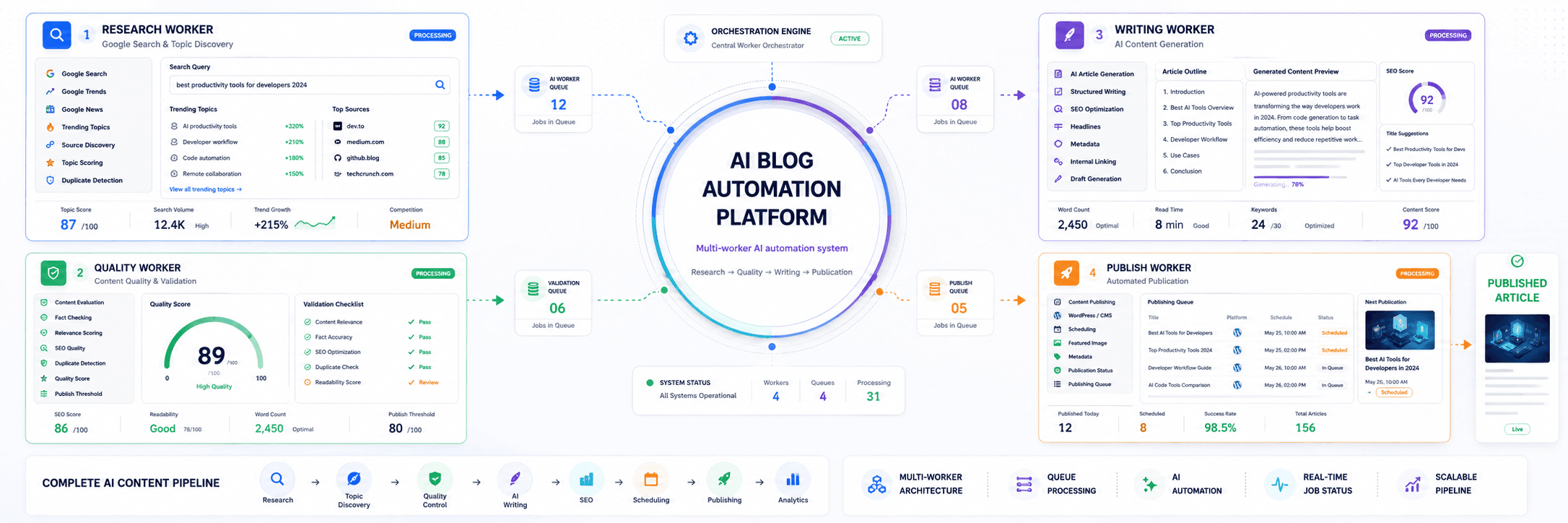
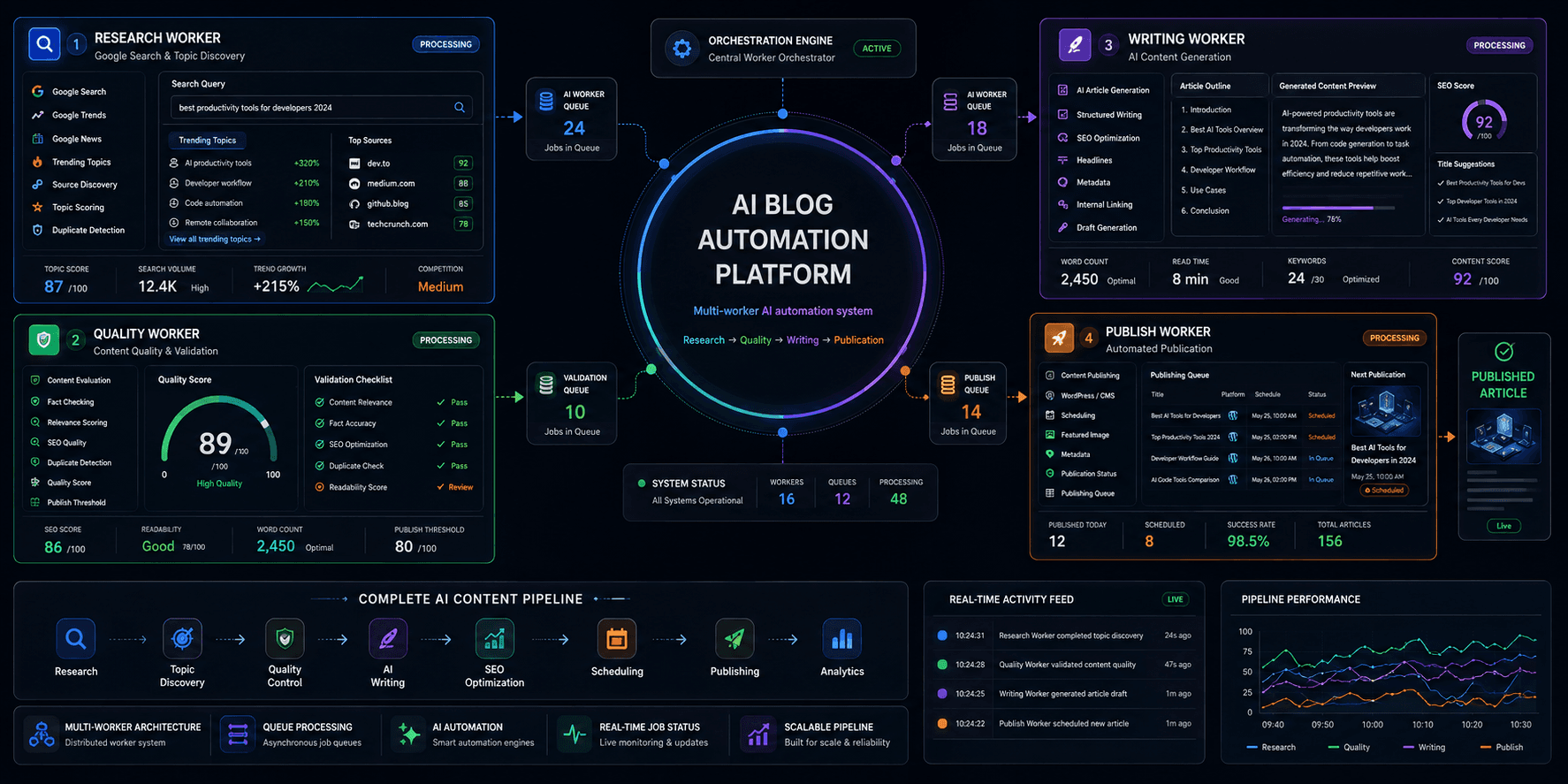
Interface Gallery & Screenshots
Visual interface layout and user dashboards designed for the system.
Technology Stack
Detailed breakdown of the architectural choices and engineering considerations behind each technology.
| Technology | Architectural Role | Selection Rationale |
|---|---|---|
| Node.js | Core Runtime | Executes the background workers and listener scripts. |
| BullMQ & Redis | Queue Coordination | Manages jobs, coordinates task queues across workers, and handles retries. |
| Gemini Pro / Vertex AI | Content Generation | Drafts outlines, generates copy, and reviews code snippets. |
| PostgreSQL | Metadata DB | Stores articles, logs task execution metrics, and logs queue history. |
Frequently Asked Questions
Answers to technical details, implementation scopes, and operations related to the project.
Related Solutions
Need a similar platform?
Explore how I build, optimize, and launch technical solutions across these service verticals.
Have a similar project in mind?
I can help design, build, and deploy custom AI solutions, SaaS portals, and full-stack web platforms. Tell me about your requirements — no sales calls required.